
Sri Lanka’s Rising Inflation Signals a Growing Policy Challenge
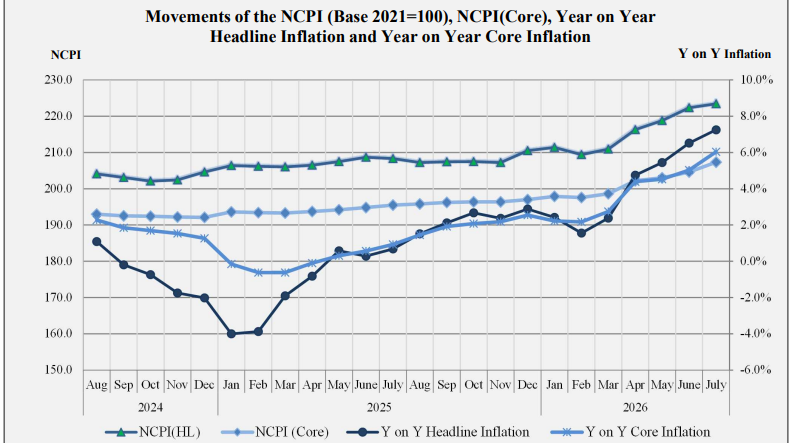
Sri Lanka’s inflation rate has accelerated sharply during 2026, rising from 2.3% in January to 8.0% in August. After declining to 1.6% in February, inflation began rising in March, reaching 2.2%, then 5.4% in April, 5.5% in May, 6.8% in June, 7.3% in July, and 8.0% in August. The continued increase highlights a growing pressure on household purchasing power and the wider economy.
The rapid rise in inflation means that households are paying more for everyday goods and services, reducing the real value of their income. As essential expenses rise, households may have to cut spending on non-essential goods and services, save less, or rely more on borrowing. This can weaken overall consumer demand and place greater financial pressure on lower- and middle-income households.
Businesses also face higher operating costs as prices for energy, transportation, raw materials, labour and other inputs increase. Companies may respond by raising prices, reducing investment, delaying expansion or cutting costs. If businesses continue passing higher costs to consumers, this can create further inflationary pressure and make it more difficult to bring inflation under control.
Rising inflation can also create uncertainty for investment and economic planning. When businesses and households cannot predict how quickly prices and costs will change, they may postpone major spending and investment decisions. Persistent inflation can therefore affect economic confidence and make long-term financial planning more difficult.
The sharp increase also creates a policy challenge for the authorities. While tighter monetary policy can help control demand and bring inflation down, higher interest rates can also increase borrowing costs and place additional pressure on households and businesses. Therefore, addressing inflation requires more than simply managing interest rates.
A broader policy response is needed to address both demand-side and supply-side pressures. Measures to improve energy security, strengthen domestic production, reduce unnecessary import dependence, improve supply-chain efficiency, and maintain stable food and energy supplies could help reduce the underlying sources of price pressure. At the same time, maintaining credible monetary and fiscal policies will be important for restoring confidence and keeping inflation expectations under control.
The movement from 2.3% inflation in January to 8.0% in August demonstrates how quickly price pressures can build within the economy. If elevated inflation persists, its effects can extend beyond higher prices, affecting household welfare, business costs, investment decisions, and economic stability. This makes coordinated and timely policy action essential to bring inflation back towards a sustainable level while protecting households and supporting economic recovery.
Posted Date: 16th September 2026