Gulf Conflict Weighs on Sri Lanka’s Tourism Recovery, Creating Spillover Risks for Real Estate
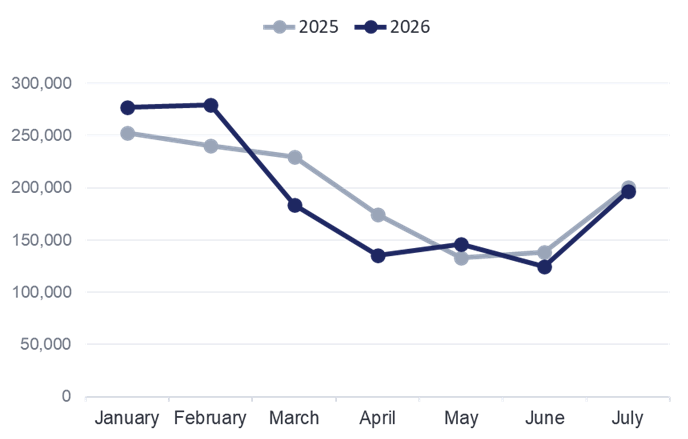
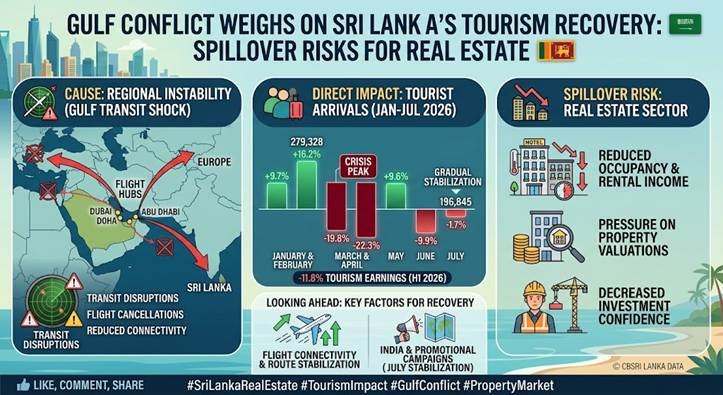
Sri Lanka’s tourism sector, which had been showing strong momentum at the beginning of 2026, faced a significant setback following the escalation of the conflict in the Middle East and the resulting disruption to air travel through major Gulf aviation hubs. The impact is visible in monthly tourist arrival figures, with the strongest declines occurring when international flight routes and connections were disrupted.
Tourist arrivals increased by 9.7% year-on-year in January 2026 and by 16.2% in February, reaching 279,328 visitors. However, the trend changed sharply from March, when arrivals fell by 19.8%, followed by a 22.3% decline in April. Although May recorded a 9.6% increase, the recovery was short-lived, with arrivals declining by 9.9% in June. In July, the decline moderated to 1.7%, with 196,845 tourists compared with 200,244 in July 2025. Overall, Sri Lanka recorded 1.34 million tourist arrivals during January–July 2026, around 1.8% below the corresponding period of 2025. SLTDA
The sharpest declines in March and April can be linked to the disruption caused by the Middle East conflict. Gulf hubs such as Dubai, Doha and Abu Dhabi are important transit points for travellers coming to Sri Lanka, particularly from Europe and other long-haul markets. Disruptions to these aviation networks resulted in flight cancellations, reduced connectivity and uncertainty among travellers. The Central Bank of Sri Lanka identified the Middle East conflict as a factor affecting Sri Lanka’s tourism performance, with the impact particularly visible during March and April. Central Bank of Sri Lanka
The effect goes beyond tourist numbers. Tourism generates demand for hotels, serviced apartments, holiday homes, restaurants, retail space and transport services, creating an important link with the property market. When tourist arrivals weaken, occupancy and rental income for tourism-oriented properties can come under pressure. Investors who purchased apartments, villas or commercial properties with the expectation of earning income from short-term visitors may experience lower returns. This could also make investors more cautious about new hotel and tourism-related property developments.
The impact can extend to the wider real estate market through reduced investment confidence and slower business activity. Lower tourism earnings mean less income flowing into tourism-dependent businesses, which can reduce their willingness to expand or lease additional commercial space. Similarly, developers may become more cautious about launching projects targeted at foreign investors or tourism-related demand. The Central Bank reported that tourism earnings fell 10.8% year-on-year in June, while cumulative tourism earnings for the first half of 2026 declined 11.8%, highlighting the financial impact of the disruption. Central Bank of Sri Lanka
However, the July figures provide some indication that the shock may be easing. The 1.7% decline in July was considerably smaller than the 19.8% and 22.3% declines recorded in March and April, suggesting that tourism demand is gradually stabilizing. The latest SLTDA data also show that July arrivals reached 196,845, compared with 200,244 in July 2025. SLTDA.
For the real estate market, therefore, the Gulf conflict represents a short-term external risk rather than necessarily a permanent deterioration in property demand. If air connectivity continues to improve and tourist arrivals recover, tourism-linked properties could regain occupancy and rental income. However, prolonged geopolitical uncertainty could delay tourism-related investment and keep pressure on hospitality and short-term rental properties. The key factor for Sri Lanka’s real estate market will be whether the recent stabilization in tourist arrivals develops into a sustained recovery during the traditionally stronger final months of the year.
Posted Date: 8th September 2026