When purchasing lands in Sri Lanka either through a mortgage loan or your funding, there is a list of documents to be submitted and some facts to be considered. The submission of these will ensure your loan is approved, your land is registered under your name, and that your land has all the basic amenities required. It also helps you get your building plan approved for you to start construction fast.
The following is a list of these documents.
Learn more about what you should consider when selecting a land plot for your construction through our webinar with Thilan Anuradha, CEO of Ehala Holdings (Pvt) Ltd.
When purchasing a land, you should also be concerned about the documentation process which is most important to prove the ownership of the property. Watch our video with Attorney-at-Law Sanjani D.S. Gamage to learn more details on this.
The following diagram is the certification process of a condominium project based on the stage of completion, and the type of documents a buyer should check if buying at the relevant construction status.
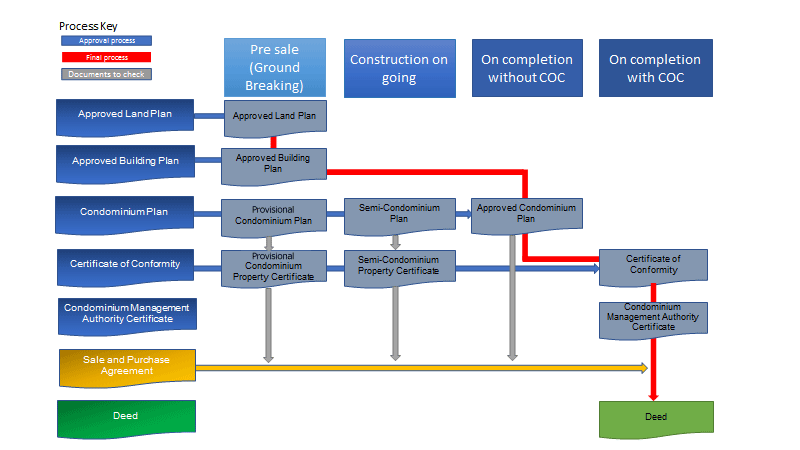
To know the documents to request from the developer during pre-launch and launch as per a freehold and leasehold property, learn more by watching our webinar with Kishore D. Reddy CEO of Platinum Realty Investments.
Once you find out all you need to know on a selected property of your choice, the next step is to work on obtaining the service of the right and experienced lawyer to help you with the other steps.
For an already built property, the final transfer of ownership and title lies on the Deed of Transfer (DOT). The seller offers an updated version of the survey plan with the DOT to register the property title with the buyer’s name in the land registry. A notary public notarizes the change in ownership and confirms the transfer. Here, the seller’s lawyer or the buyer’s lawyer can also act as the Notary Public without the involvement of a third party Notary.
As the buyer, you don’t necessarily have to be present at the signing of the DOT. It's the seller that signs it in the presence of the lawyers and two witnesses and your agent/lawyer may work by settling payment balances, estate agent fees, etc. He will also receive the keys of the property and title documents on your behalf and register the DOT while notifying the local council or municipality of the change in ownership. Finally, once the registration is completed, you will receive the Registered Deed of Transfer from the Land Registry. However, both the buyer and seller shall be at the same place and time when signing the Deed of Transfer under Title Registration of Bim Saviya
Good luck and good fortune are two things that everyone wishes their homes should be filled with. To achieve this, many people follow different concepts, arrangements, and other details that are considered in designing the construction process.
Vaastu Shastra is one such concept that applies to a house when it is being built from scratch. While Feng Shui is some kinds of practices and principles that can be applied to your home at any time. The Vaastu Shastra originates from India and means dwelling science. Some would even recognize Vaastu shastra as the Indian version of Feng Shui, with an origin of over 1500 years. It is a concept that also has a relationship with astrology and good directions.
Feng Shui originates from China and like Vaastu Shastra, it is also about spreading positivity, bringing good luck and good fortune. However, unlike the Vaastu shastra, it is based on a concept of using energy forces to harmonize an individual with his or her surrounding environment. Its purpose is to achieve harmony and balance.
According to the two concepts, every little arrangement including the colours you use to paint your house and the arrangement of furniture and fittings can impact the positive energy and the relationship of the members in the home.
To promote this positivity, Vaastu Shastra and Feng Shui recommend a variety of different practices and arrangements. Read more about what you can do to improve this positive energy and bring good fortune to your home from our article, Vaastu Shastra and Feng Shui: 9 Ways to Maximize Wealth and Prosperity in your House.
A deed can be described as a legal document that gives title/ownership to private land. It is different from a registration of title that gives a clearer understanding of the ownership of a particular property. The deed has different forms that it takes depending on the way that the ownership of the property is transferred.
This is a type of deed that is prepared when a property is transferred from one person to another. The information included in this document is the names, addresses, and NIC numbers of the two parties (transferor and transferee), details about the previous deed that gave the transferor the title to the property, and the selling price/consideration. Once the transferor signs the document before two witnesses and it is attested by the Notary, the transferee then gets ownership of the property.
This is a document used to transfer the ownership of a property to another person without monetary consideration.
An exchange deed is a type of deed registered between owners of properties in order to exchange the properties between the transacting parties. The transaction is different from a conventional property sale because there is no transfer of money between the parties.
To claim or declare ownership rights of property legally, a deed of declaration is executed. The person who can execute this document to declare that he holds the title to the particular property is usually someone who has had undisturbed and uninterrupted possession of the property for more than 10 years. But here it is practically impossible for the Notary to verify the possession of the property by the declarant. Because of this as a precaution, it is recommended that the Notary gets an affidavit mentioning details on the period of possession of the particular property.
A deed of declaration can also be executed when a person dies without a will. Here the rightful owners whom the property could be divided amongst can execute the deed to claim ownership or declare their rights as beneficiaries.
The President has the power to grant a land to any citizen of Sri Lanka as per the Land Grants (Special Provisions) Act No.43 of 1979.
A last will is a declaration made by a person on how his/her property should be distributed among the beneficiaries after his death. This document overrides all other laws related to succession after the owner passes away.
This is a supplementary deed document to the last will. Here additions or alterations made to the contents mentioned in the last will are recorded.
Find out more about deeds by reading our article, Types of Deeds in Sri Lanka (…….)
Frauds in any industry are unavoidable. In Sri Lanka, frauds in real estate are especially high because of the lack of information and knowledge in the industry available for buyers and sellers.
These real estate scams take place at different levels, starting from a simple call to a fake transfer of money, name changes in the deed, and creating fraudulent deeds. To prevent falling for these, better to consider purchasing a property through a bank loan or working with a trusted real estate agent or getting the assistance of a knowledgeable lawyer
You can find out more about how to avoid these scams from our article, everything you need to know on property scams and how to avoid them.
Property valuation helps you determine the value of your property based on its location, its condition, and other factors. The valuation is carried out by a professional surveyor and the report he generates can be used to determine the selling price of your property if you are thinking of selling it someday. Valuation also helps determine a monetary division of your property when separating from a partner, or when dealing with probate.
However, you should also know that with valuations;
To get the best valuation for your property contact LankaPropertyWeb through our Buyer and Seller assistance service program.
The Buyer and Seller Assistance Service was launched by LankaPropertyWeb to ease the property buying, selling, and renting process for first-time homebuyers, sellers, and landlords. The service offers property valuations conducted by professional surveyors, legal assistance from lawyers, assistance on the document preparation and submission process (deeds or tenancy agreements), mortgage advice, tax payments, market research and advisory, personal assistance, and other services such as moving services, insurance, and photography.
Through our expertise, you can now ease the hassle of dealing with the property and save time with your property transactions easily. To find out more about how the Buyer & Seller Assistance program can take the hassle out of buying or selling property, please contact us by clicking here.
Please enter below any questions or recommendations to improve this article